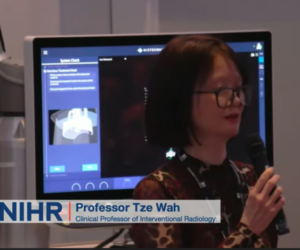
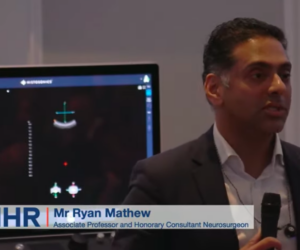
Theme Leads: Professor Tze Min Wah and Mr Ryan Mathew
Background
Technology is transforming surgical care, enabling therapies to be delivered with greater precision, minimal trauma, and improved outcomes (https://futureofsurgery.rcseng.ac.uk). Patients benefit from less morbidity, shorter lengths of stay and faster recovery, whilst hospitals benefit from reduced costs, greater efficiency and cost-savings.
Digital enhancement along the entire surgical pathway, combined with real-time intra-operative data and robotic assistance, are pushing the boundaries of surgical capability. Rich patient datasets combined with artificial intelligence/machine learning are enabling us to better understand the complexities of surgical care and tailor treatments to individual patient needs.
The integration of digital technologies, including immersive realities and remote patient monitoring, into clinical practice and the benefits they bring for preoperative education, operative planning, surgical rehearsal and performance, and post-operative recovery are only just beginning to be realised. The adoption of remote proctoring provides accelerated learning, whilst reducing the carbon footprint of traditional training methods.
Advances in mobile digital technologies opens the reality of “virtual wards”, allowing patients to be discharged quickly and safely from hospital into the community, freeing valuable hospital resources, or to be monitored and treated in their own homes without the need for repeat hospital visits.
Areas of Focus
This theme will bring together clinicians, academics, industry, professional bodies, and the public and patients to harness the power of digital, data, and surgical devices and accelerate innovation uptake into the NHS based on robust evidence of safety and cost effectiveness. It will seamlessly bridge the two other technology themes, allowing more patients with early-stage disease to benefit from minimally invasive treatments, spend less time in hospital, and recover safely in the community.
We will work across:
- Orthopaedic,
- Transplantation,
- Emergency Surgery,
- General Surgery,
- Vascular,
- Colorectal,
- Liver/Pancreas/Gallbladder (HPB) and
- Neurosurgery.
Development of technology for anastomotic leak detection for colorectal surgery
Using virtual and augmented reality 3D holographic images for Hepatopancreatobiliary Surgery
Prospective multicentre open clinical study to assess the safety performance and durability of the TIES® transcutaneous titanium implant in patients requiring a permanent ileostomy
A validation study of contactless remote photoplethysmography for vital sign monitoring
3D navigation system that enables real-time anatomical tracking during spinal surgery
Sub-dermal imaging modality for diagnosing peripheral artery disease
An inexpensive, fast and reliable estimation of cardiorespiratory fitness VO2-max estimation
Continuous monitoring of drain pH and electrical conductivity in patients with gastrointestinal anastomosis
Surgically implanted body-computer interface for monitoring of disease via electrical signals
Using Behavioural AI for the Early Detection of Brain Cancer
Educating healthcare workers and patients using immersive technologies
The HistoSonics System for treatment of primary and metastatic liver tumours using histoptripsy
Hepatocellular carcinoma is one of the leading causes of cancer related mortality worldwide. Only 10% -20% of patients with liver tumours are eligible for surgical resection and there can be limitations with image-guided thermal ablation and the current non-thermal ablative techniques. The HistoSonics device uses histotripsy, a form of therapeutic focused ultrasound to mechanically destroy primary and metastatic liver tumour targets. Short, high intensity pulses are delivered through ultrasound energy which induces controlled cavitation to mechanically liquify tumour targets without damaging non-target tissue.
The HOPE4LIVER clinical trials investigated the safety and efficacy of histotripsy through 14 sites across Europe and the US. Professor Tze Min Wah, Senior Consultant radiologist and Clinical lead for Interventional Oncology at Leeds Teaching Hospital NHS Trust led the trial in the UK. Following the worldwide completion of the trial the safety and technical success of the HistoSonics histotripsy system for the targeted destruction of liver tumours was confirmed. This novel sonic beam therapy is non-thermal, non-ionising, non-invasive and could provide a great option in the treatment of liver cancer without the need for any needles of incisions.
Positive results from early phase trials have led to histotripsy for the treatment of liver cancer to be adopted into the Innovative Devices access Pathway (IDAP). One of 8 medical technologies selected from across the UK, through IDAP the integration of the HistoSonics system into the NHS has been expedited and in March 2025 received approval for use in select NHS sites across the UK. Histotripsy addresses a significant patient need providing more accessible and non-invasive alternatives to conventional treatments.
There are plans for larger clinical trials and evaluation of the health economics of histotripsy as this technology has the potential to not only improve quality of life and reduce hospital stay, but also reduce the resources required from the NHS through fewer post-operative complications, opioid management etc. In addition, broadening the scope of histotripsy is already in motion with pilot trials using histotripsy for renal tumours currently nearing completion.
The Zeiss Convivo Pathology Suite for Brain Tumours
A robotic camera system that makes bowel examinations easier for patients and more efficient for hospitals.
Diseases of the large bowel (colon) are a major burden on the NHS. They are usually diagnosed using a camera test (colonoscopy). Around 200,000 NHS colonoscopies are performed each year, each costing ~£372 per patient. Colonoscopy can be uncomfortable for patients and may require time off work or care from family members during preparation and recovery. Colonoscopies can lead to a life changing diagnosis or reassure patients that they don’t have disease. A shortage of specially trained healthcare professionals who can perform colonoscopies has led to long waiting times and possible delays in diagnosis and treatment.
Robotic systems are more precise, safer, do not suffer from tiredness, can operate 24/7 and reduce complications from human error. But robots are expensive, and their benefits must be balanced against their increased costs.
An award winning (KUKA Innovation Award 2019) new robotic magnetic colonoscope (camera) has been developed by engineers at the University of Leeds, clinicians at LTHT, and industry (Atlas Endoscopy). Our robot’s advanced design and operating features mean it is kinder for patients because the low volume camera is gently pulled around the bowel rather than pushed by a camera operator (endoscopist). It is also easier to use, and potentially better at detecting disease than standard colonoscopy. Its components are cheap and might save the NHS money. In the future, examinations could be performed with minimal human assistance (semi-autonomously), meaning more examinations for less money. Our robotic colonoscope is undergoing first-in-human clinical studies in LTHT, funded by Cancer Research UK (£1.2m) and supported by Leeds CTRU and Leeds NIHR Surgical Technologies MIC, to determine its performance in routine clinical work and settings.
Working with the HRC-ASC, we will develop and commercialise our robotic colonoscope, benefiting from the HRC’s expertise in clinical and economic evaluations for bowel disease (doi.org/10.1001/jama.2017.7219) and access to expertise in market access and medical device regulations. Our previous experience in evaluating robotic medical systems, taking into account “real world” factors, such as time taken for surgeons to become experts and perform robotic surgery safely, has been used by healthcare providers across the world to plan how best to deploy surgical robots, and by other manufacturers (CMR Surgical, UK, and Distalmotion, Switzerland) to develop low-cost systems that will mean more patients can benefit from robotic surgery.
Coming soon…..
Manuscript Accepted: ‘Management of subcutaneous abscesses: Prospective cross-sectional study (MAGIC)’
The #HOPE4LIVER Single-Arm Pivotal Trial for Histotripsy of Primary and Metastatic Liver Tumors Published Online:Sep 3 2024 https://doi.org/10.1148/radiol.233051
Histotripsy for the treatment of primary solid renal tumours (CAIN study)
Partial nephrectomy and thermal ablations are the current standard of care kidney therapies. However, they are invasive and can lead to complications through bleeding and infection. Histotripsy, which uses focused ultrasound to destroy target kidney tissue through a non-thermal mechanical process could provide an alternative non-invasive treatment option. Furthermore, it’s mechanical mechanism of cell destruction could help preserve kidney function.
The HistoSonics system has been used to deliver histotripsy treatment of solid renal tumours as part of the CAIN trial and follows the successful HOPE4LIVER trial which utilised histotripsy for the treatment of liver tumours. Professor Tze Min Wah, Senior Consultant radiologist and Clinical lead for Interventional Oncology at Leeds Teaching Hospital NHS Trust delivered the first ever histotripsy treatment for kidney patients using the HistoSonics system in March 2023 with recruitment for the trial ending mid-2024. This pilot study evaluated the technical success and safety profile of the histotripsy system in targeting and destroying primary renal tumours. Initial results are promising with the hope that histotripsy for the targeted destruction of renal tumours will become an alternative treatment option for kidney cancer patients in the UK.
Throughout the study there has been a strong focus on Patient and Public Involvement and Engagement (PPIE). At the early stages of trial development, PPIE meetings were held to receive feedback on the CAIN study. Current and former patients as well as family members and general members of the community reviewed the study and corresponding documents, with their valuable comments helping shape the final study.
As the trial neared its conclusion 8 participants of the CAIN trial took part in the NIHR Participant in Research Experience Survey (PRES). PRES is a national standardised survey that is used to collect the views and experiences of participants involved in NIHR supported research. PRES aims to put participant experience to the forefront of research delivery and use this data to improve accessibility, recruitment and retention to studies. Furthermore, this data helps inform and guide study design and delivery.
PRES data from the CAIN study showed participants had an overwhelmingly positive experience will all stating they would consider taking part in research again. The CAIN study trialled a highly innovative and novel treatment and it was found that participants had a high level of willingness to try new novel therapies and high levels of motivation to help other future technologies.
PRES data from the CAIN trial highlighted that the involvement of PPIE groups throughout the course of the study not only helps deliver a successful trial but also one where patients are encouraged to participate in research again.
Coming soon…..